
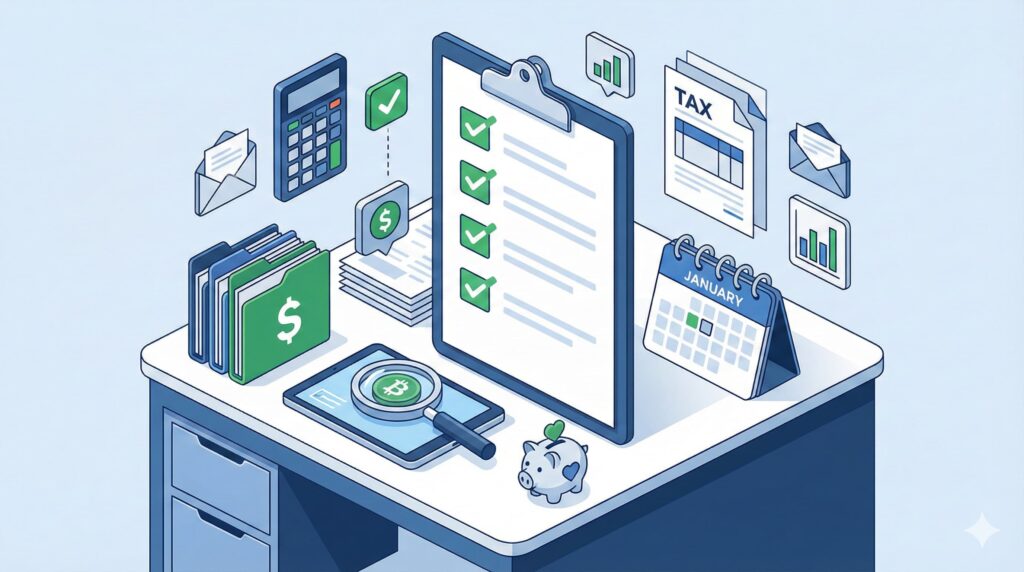
Most taxpayers view March and April as the months of “tax panic.” But the secret to a stress-free filing and a faster refund is actually hidden in January.
By the time February rolls around, you should have the majority of your documentation ready. Early organization doesn’t just save you from headaches; it ensures that you don’t miss out on the valuable deductions introduced by the latest 2026 tax laws.
Here is your step-by-step checklist to master the 2026 tax season.
1. Gather Your Income Documents (The Paper Trail)
By law, employers and financial institutions must send out most tax forms by early February. Keep an eye on your mailbox and your email for these key documents:
- Form W-2: If you were an employee in 2025.
- Form 1099-NEC: For freelancers and independent contractors.
- Form 1099-K: If you received over $20,000 through apps like PayPal, Venmo, or Stripe.
- Form 1099-INT/DIV: For interest and dividends earned from your bank or investments.
2. For Business Owners: The Financial “Big Two”
If you run a business or are self-employed, simply having your receipts isn’t enough. To maximize your deductions and stay compliant, you need organized financial reports.
- Profit and Loss Statement (P&L): This summarizes your revenues, costs, and expenses. It is the foundation of your tax return.
- Balance Sheet: This provides a snapshot of your business’s assets, liabilities, and equity.
Accounting Heart Tip: Having these two documents ready before you meet with your tax professional can cut your preparation time in half and help identify tax-saving opportunities you might have missed.
3. Digital Assets and Crypto (New for 2026)
The IRS has significantly increased its focus on digital assets. For the 2025 tax year (filing in 2026), there are new reporting requirements:
- Form 1099-DA: Watch for this new form from your crypto brokers and exchanges. It reports the gross proceeds from your digital asset sales.
- Transaction Logs: Even if you don’t receive a form, you are required to report gains from trading, staking, or receiving crypto as payment.
4. Checklist for Deductions and Credits
Don’t let “forgotten” expenses increase your tax bill. Ensure you have records for:
✔ Mortgage Interest: Form 1098 from your lender. ✔ Education Expenses: Form 1098-T (tuition) or 1098-E (student loan interest). ✔ Childcare Costs: You will need the provider’s name, address, and Tax ID (EIN/SSN). ✔ Charitable Donations: Receipts for cash and non-cash gifts. ✔ Medical Expenses: If they exceed a certain percentage of your income.
5. What This Means for You in 2026
Filing early is about more than just beating the April 15 deadline:
- Faster Refunds: The IRS processes early returns much quicker, meaning money hits your bank account sooner.
- Identity Protection: Filing early is one of the best ways to prevent tax identity theft.
- Better Planning: If you do owe money, filing early gives you until April to figure out the best way to pay without being in a rush.
Maximize Your Refund with Accounting Heart
Tax laws have changed significantly this year, and “DIY” tax software often misses the nuances that a professional can catch. At Accounting Heart, we don’t just file your forms—nosotros diseñamos tu estrategia.
We help you:
- Organize your P&L and Balance Sheet so they are IRS-ready.
- Navigate the new Form 1099-DA for crypto and digital assets.
- Identify the maximum credits for your family and business.
- Ensure every deduction is supported by proper documentation.
Ready to file with confidence?
Don’t wait until the March rush. Starting your preparation now is the best gift you can give your business and your wallet.
👉 [Schedule your pre-tax consultation with Accounting Heart today] and let’s make 2026 your most profitable year yet!