
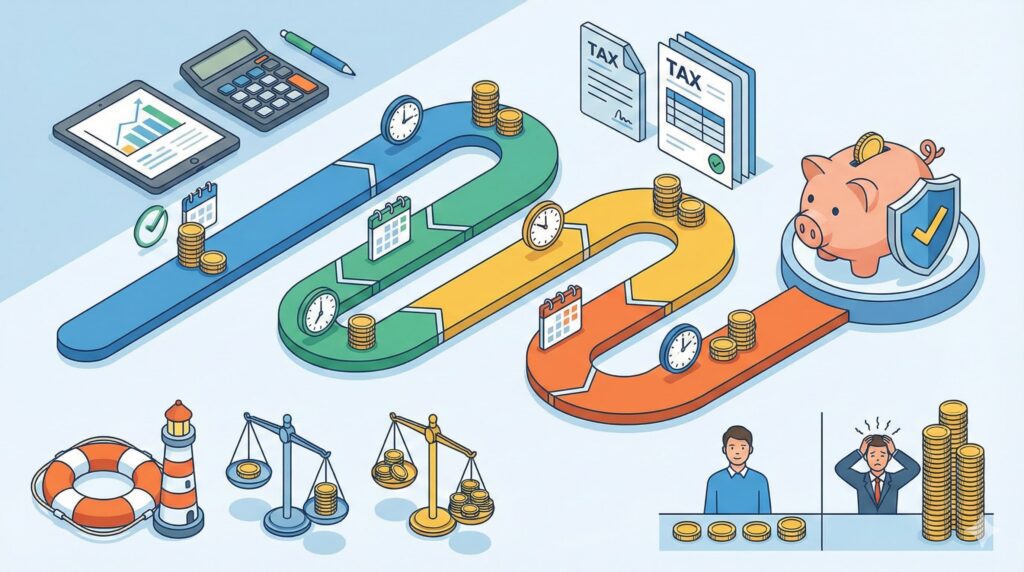
For many new entrepreneurs, the biggest shock isn’t just the amount of tax they owe—it’s when they have to pay it. Unlike a traditional job where taxes are taken out of every paycheck, the U.S. tax system for business owners is a “pay-as-you-go” system.
If you wait until April to pay your total tax bill, you will likely be met with an “Underpayment of Estimated Tax” penalty. To avoid this, you must make Quarterly Estimated Tax Payments.
Here is everything you need to know to stay compliant in 2026.
1. Who is Required to Pay Quarterly Taxes?
As a general rule, you must make estimated tax payments for the 2026 tax year if both of the following apply:
- You expect to owe at least $1,000 in tax for 2026 after subtracting your withholding and credits.
- You expect your withholding and credits to be less than the smaller of:
- 90% of the tax to be shown on your 2026 tax return.
- 100% of the tax shown on your 2025 tax return.
This applies to sole proprietors, partners, S-Corporation shareholders, and freelancers.
2. The 2026 Quarterly Deadline Calendar
Missing a deadline by even one day can trigger interest charges. Mark these dates in your calendar now:
- 1st Payment (Jan 1 – March 31): Due April 15, 2026
- 2nd Payment (April 1 – May 31): Due June 15, 2026
- 3rd Payment (June 1 – Aug 31): Due September 15, 2026
- 4th Payment (Sept 1 – Dec 31): Due January 15, 2027
3. How to Avoid Penalties: The “Safe Harbor” Rule
The IRS doesn’t expect you to know exactly how much you will earn by the end of the year. To protect you from penalties, they offer the Safe Harbor rule. You will not owe a penalty if you pay:
✔ The 90% Rule Pay at least 90% of the tax you will owe for the current year (2026).
✔ The 100% Rule (Prior Year) Pay 100% of the tax shown on your 2025 return. This is the safest way to avoid penalties if your income has increased significantly this year.
- Note: If your Adjusted Gross Income (AGI) was over $150,000, you must pay 110% of the prior year’s tax.
4. How to Calculate Your Payment Amount
To calculate your estimated tax, you must estimate your expected adjusted gross income, taxable income, taxes, deductions, and credits for the year.
- Estimate your Profit: Take your expected total income and subtract your business expenses.
- Calculate Self-Employment Tax: This is currently 15.3%.
- Calculate Income Tax: Apply your estimated tax bracket.
- Divide by Four: Split the total into four equal payments.
5. Why Quarterly Payments Matter for Your Cash Flow
Aside from avoiding penalties, paying quarterly helps your business maintain a healthy cash flow.
- No “April Surprise”: It’s much easier to pay $5,000 four times a year than to come up with $20,000 all at once in April.
- Accurate Financial Planning: Knowing your tax liability throughout the year allows you to know exactly how much “real” profit you have left to reinvest in your business.
How Accounting Heart Keeps You Ahead of the IRS
Calculating estimated taxes can be complex, especially if your income fluctuates. At Accounting Heart, we take the guesswork out of the process so you can focus on running your business.
We help you:
- Calculate Accurate Estimates: We look at your real-time Profit & Loss to ensure you aren’t overpaying or underpaying.
- Avoid Penalties: We ensure you meet the “Safe Harbor” requirements every single quarter.
- Manage Deadlines: We send you reminders and help you make your payments electronically through the IRS systems.
- Optimize Deductions: We find ways to lower your taxable income throughout the year, not just at the end.
Stop Guessing and Start Growing
Don’t let the fear of a tax penalty slow down your business growth. Let the experts handle the calculations.
👉 [Contact Accounting Heart today] to set up your 2026 Quarterly Tax Strategy and ensure you never pay a penny more in penalties than you have to.