
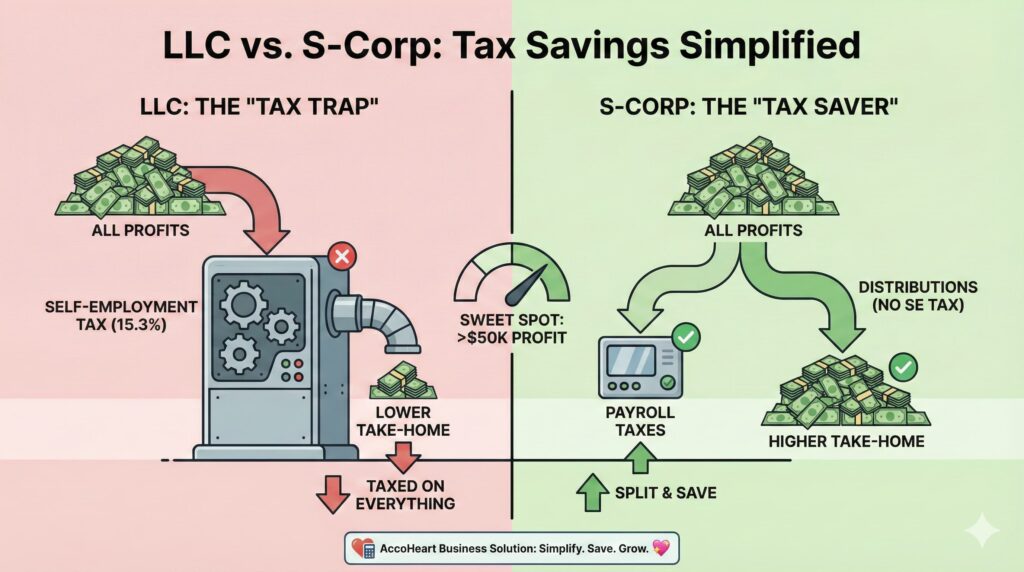
Many small business owners in the U.S. start their journey as a Limited Liability Company (LLC) because of its simplicity and legal protection. However, as your business grows, that same simplicity can become a “tax trap,” forcing you to pay thousands of dollars in unnecessary taxes.
Why do some entrepreneurs pay less in taxes while earning the same amount? The answer usually lies in the S-Corp tax election.
Here is everything you need to know to decide if 2026 is the year to make the switch.
1. The Hidden Problem with the LLC: Self-Employment Tax
When you operate as a single-member LLC, the IRS views 100% of your net income as “self-employment earnings.” This means you pay a 15.3% self-employment tax on all your profits.
This tax covers:
- Social Security
- Medicare
As your income rises, this 15.3% becomes a significant amount of money leaving your pocket before you even touch your personal income taxes.
2. The S-Corp Strategic Advantage
An S-Corp is not a different type of legal entity, but a tax classification you request from the IRS. The big difference is how your money is distributed:
- Reasonable Salary: You pay yourself a wage as an employee of your own company. You only pay payroll taxes on this specific amount.
- Distributions (Dividends): The remaining business profits are paid to you as distributions, which are not subject to the 15.3% self-employment tax.
The Result: You save thousands of dollars per year by “shielding” a portion of your earnings from Social Security and Medicare taxes.
3. The Concept of “Reasonable Salary”
For the IRS to accept your S-Corp structure, you must pay yourself a salary that matches what someone else would earn doing your job in your industry.
You cannot set a $1 salary just to avoid taxes. You must establish a fair figure, and anything above that can be taken as tax-free (from a self-employment perspective) profit. At Accounting Heart, we specialize in helping you determine exactly what that number should be to keep you compliant while maximizing your savings.
4. When is the Ideal Time to Switch?
An S-Corp isn’t always the best choice from day one. In 2026, the general rule we apply for our clients is based on your net profit:
- Under $50,000 in profit: Generally, it is better to stay as an LLC due to the administrative costs of running payroll.
- Over $50,000 in profit: This is the “sweet spot” where tax savings start to significantly outweigh the operational costs.
5. What This Means for Business Owners in 2026
If you decide to transition to an S-Corp this year, the benefits are clear:
✔ Immediate Tax Savings You could reduce your tax burden by $3,000 to $10,000+ annually, depending on your income.
✔ Increased Business Credibility Operating under a more formal corporate structure often opens doors with banks, lenders, and commercial partners.
✔ Optimized Retirement Planning As an employee of your own corporation, you gain access to retirement plans that can offer even higher deductions.
✔ IRS Peace of Mind Having a clear structure of payroll and dividends reduces ambiguity in your accounting and better prepares you for any future reviews.
How Accounting Heart Business Solution Helps You Grow
Navigating tax laws can be overwhelming, but you don’t have to do it alone. At Accounting Heart, we turn accounting complexity into a strategic advantage for your business.
We handle:
- Evaluating if an S-Corp is the best fit for your current situation.
- Filing the tax election paperwork with the IRS.
- Managing your Payroll to ensure you meet “Reasonable Salary” requirements.
- Optimizing your deductions so you keep more of what you earn.
- Ensuring your books are ready to maximize every 2026 tax benefit.
Ready to Stop Overpaying in Taxes?
Don’t let a lack of tax strategy stall your company’s growth. At Accounting Heart, we analyze your income and design the financial path you and your business deserve.
👉 [Click here to contact Accounting Heart] and request your financial analysis today to discover how much you could save with an S-Corp.