
Many small businesses ask the same question when they start hiring: “Can I just pay in cash?”
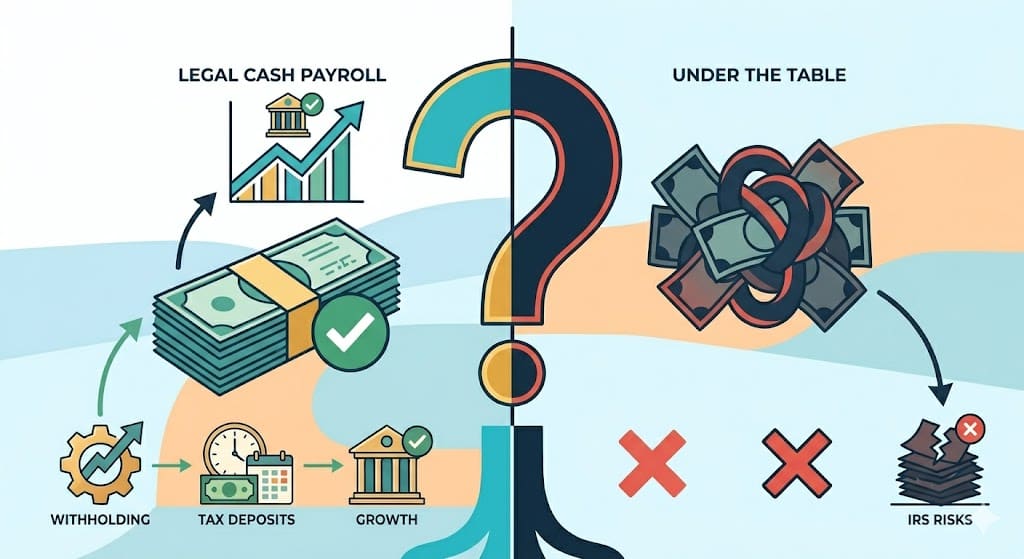
The short answer is: yes, paying in cash can be legal—but only if it’s still processed as payroll (with the right withholding, deposits, reporting, and records). The problem is that “cash pay” is often confused with “under the table,” and that’s where IRS issues start.
In 2026, the IRS has strong matching systems: if wages, deposits, quarterly forms, and W-2s don’t line up, it can trigger notices, penalties, or audits.
Here is what you need to know to pay workers correctly—whether you pay by cash, check, or direct deposit.
1. “Cash” Is a Payment Method—Not a Tax Shortcut
The IRS doesn’t care how you hand money to your worker. It cares whether that payment is treated correctly as wages (employee) or contractor pay (independent contractor).
If someone is your employee, you generally must withhold federal income tax, Social Security, and Medicare, and you must also pay the employer portion of Social Security/Medicare and unemployment taxes.
So even if you pay in cash, the tax rules do not disappear—only the recordkeeping becomes more important.
2. The First IRS Question: Employee or Independent Contractor?
Before you decide “cash vs payroll,” the real decision is: W-2 employee or 1099 contractor?
The IRS explains that worker status depends on facts and the level of control (not what you call the worker).
If you’re unsure, the IRS provides guidance and even a process to request a determination (Form SS-8).
This matters because:
- Employees (W-2): require withholding + payroll tax deposits + Forms 941/940 + W-2 reporting.
- Contractors (1099): generally no withholding by default, but you still need clean records and correct reporting when required.
3. What “Doing Payroll” Actually Means (Even If You Pay in Cash)
If it’s an employee, “payroll” is the compliance system around the paycheck:
- Withhold federal income tax (based on Form W-4)
- Withhold and match Social Security + Medicare (FICA)
- Deposit withheld taxes + employer taxes on time (monthly or semiweekly schedule)
- File quarterly payroll returns (generally Form 941)
- Issue W-2s and file them properly
Important detail: IRS deposit rules are based on the dates when wages are paid (cash basis)—so paying in cash doesn’t avoid payroll rules; it simply means you must track pay dates and liabilities carefully.
4. The Biggest Risk of “Paying Cash”: Missing Reporting (W-2 / 941 Mismatches)
This is where many businesses get into trouble:
- They pay cash
- They don’t run it through payroll
- They don’t deposit taxes
- They don’t file 941 correctly
- They “forget” W-2s
But the IRS is clear that employers who pay employee compensation generally have W-2 filing obligations.
If your quarterly totals (Form 941) don’t align with your annual wage reporting totals (W-2/W-3), it can create compliance headaches.
5. Payroll Recordkeeping: What the IRS Expects You to Keep
Even if your payroll is perfect, weak documentation can create problems later.
The IRS states employers should keep employment tax records for at least four years and have them available for IRS review.
If you pay in cash, recordkeeping becomes non-negotiable:
- Payroll register (dates, gross, net, withholdings)
- Proof of tax deposits
- Copies of filed returns (941/940)
- Signed W-4s
- Pay stubs or wage statements (often required by states—even when paid in cash)
6. The “Safe Way” to Pay in Cash (Without Creating IRS Problems)
If you truly need to pay in cash (example: same-day pay), the safe approach is:
- Classify the worker correctly (employee vs contractor)
- Run payroll calculations (gross pay, withholding, employer taxes)
- Pay the net amount in cash and issue a pay stub/receipt
- Deposit payroll taxes on your required schedule
- File Form 941 (and other required forms)
- Issue W-2 at year-end
What you should not do: “cash under the table.” Besides being illegal, it creates the exact mismatch patterns that lead to IRS letters and costly cleanups.
[Image suggestion: A simple decision graphic: “Cash Pay vs Payroll” showing: Employee → Payroll rules apply; Contractor → record + possible 1099; “Under the table” → risk zone]
Why Accounting Heart Helps You Pay the Right Way
Most payroll problems don’t happen because a business owner is trying to do something wrong—they happen because payroll is treated like “just payments,” instead of a system.
At Accounting Heart Business Solution (Accoheart), we help you:
- Set up payroll correctly (withholding + deposits + reporting)
- Avoid worker misclassification issues
- Keep payroll records organized for IRS review
- Keep 941/W-2 reporting consistent so your numbers match
Payroll should protect your business—not expose it.
👉 [Contact Accounting Heart today] and we’ll help you build a payroll process that’s clean, compliant, and stress-free.