
Childcare is one of the biggest expenses for working families—but many taxpayers don’t realize the IRS offers a credit that can reduce their federal tax when care is paid so you can work (or look for work).
The problem is that this credit is also one of the easiest to claim incorrectly. A single issue—like listing an ineligible provider, mixing school tuition with care, or missing provider ID—can reduce the credit to zero or trigger IRS follow-up.
Here is what you need to know to claim the Child & Dependent Care Credit correctly in 2026 (tax year 2025 filing).
- Who Qualifies for the Credit (It’s Not Just “Any Childcare”)
To claim the credit, the care must be for a qualifying person, and the expenses must be work-related.
A qualifying person is generally:
- A dependent child under age 13, or
- A spouse or dependent of any age who is physically or mentally unable to care for themselves (and meets the living-with-you rules).
And the care must be paid so you (and your spouse, if married filing jointly) can work or actively look for work.
If you (or your spouse) have no earned income for the year, the credit is often limited or not available—because this is a work-related credit.
- What the IRS Counts as “Qualified Care” (and What Does NOT Count)
This credit is specifically for care, not education or general child expenses.
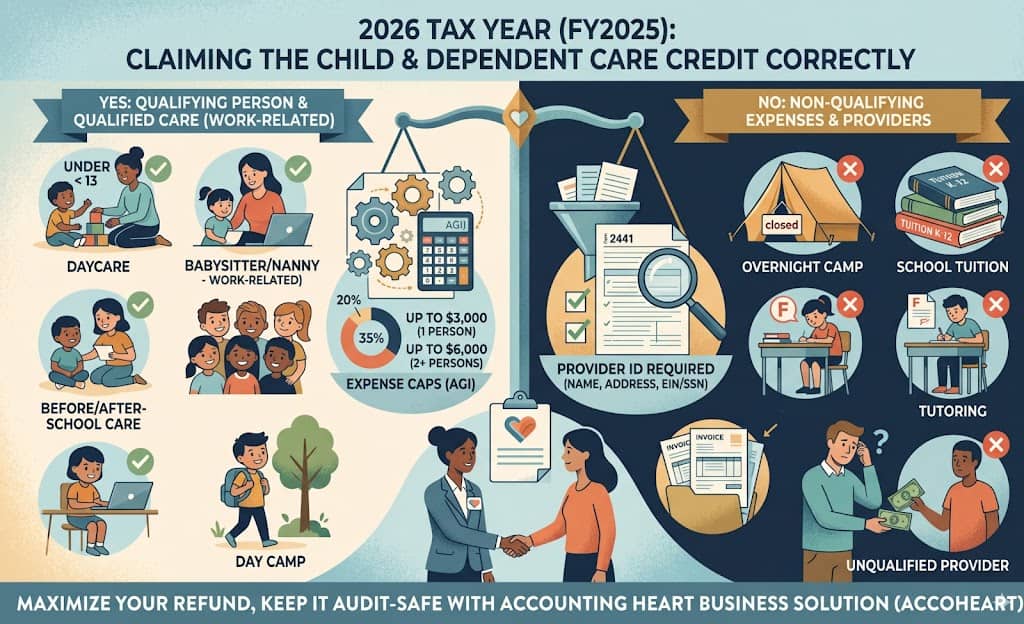
Qualified care may include:
- Daycare centers and licensed childcare
- Babysitters or nannies (when properly reported)
- Before- and after-school care (when it’s care—not tuition)
- Day camp (even if it focuses on activities like soccer or computers)
What does NOT qualify (common mistakes):
- Overnight camps (the IRS does not treat this as a work-related care expense)
- Tuition for kindergarten or higher grades (school is not “care”)
- Summer school or tutoring (education is not “care”)
- Costs that are mainly for food, entertainment, or education (unless they are incidental and cannot be separated from the care cost)
If a bill includes both education and care, the IRS expects you to separate the care portion—or you risk losing the credit.
[Image suggestion: A simple “Qualifies vs. Doesn’t Qualify” graphic (Daycare / After-school care / Day camp vs. Overnight camp / School tuition / Tutoring)]
- How the Credit Is Calculated in 2026 (Limits + Percentages)
Two things control how much you can claim:
A) The expense limit
There is a yearly cap on expenses used to calculate the credit:
- Up to $3,000 of qualified expenses for one qualifying person
- Up to $6,000 for two or more qualifying persons
Even if you spent $10,000+ on care, the credit calculation uses only up to these limits.
B) The percentage (based on income)
The IRS applies a percentage to your eligible expenses—up to 35%, depending on your adjusted gross income (AGI). As income increases, the percentage decreases until it reaches 20%.
C) Important: Dependent Care FSA can reduce your credit
If your employer provides dependent care benefits (often through a Dependent Care FSA), those amounts generally reduce the expenses you can use for the credit.
Example concept:
If you have two children, your cap is $6,000. If you used $5,000 in Dependent Care FSA benefits, you may have only $1,000 left that can be used toward the credit calculation.
- The #1 Reason People Lose This Credit: Provider Rules
Even if your expenses qualify, you can still lose the credit if the provider is not eligible or not properly identified.
You must list the provider’s:
- Nombre
- Dirección
- EIN or SSN
And your provider cannot be:
- Your spouse
- The parent of the child (if the qualifying person is your child under 13)
- Someone you can claim as a dependent
- Your child under age 19 (even if they aren’t your dependent)
This is also why many returns get flagged: the IRS expects provider info to match real records.
Your filing checklist:
- Keep invoices and payment records
- Make sure provider info is complete and accurate
- Use the correct tax form (Form 2441)
- Don’t double count expenses paid through a Dependent Care FSA
Why Accounting Heart Keeps Families Safe (and Maximizes the Credit)
Most people don’t lose this credit because they aren’t eligible—they lose it because the IRS rules are very specific.
At Accounting Heart Business Solution (Accoheart), we help families:
- Confirm eligibility (qualifying person + work-related rules)
- Separate “care vs. education” costs correctly
- Coordinate Dependent Care FSA benefits with the credit
- File Form 2441 correctly with valid provider details
- Reduce IRS mismatch risks and refund delays
Childcare is expensive. Your tax strategy shouldn’t be confusing.
👉 [Contact Accounting Heart today] to claim the Child & Dependent Care Credit correctly and keep your return audit-safe.