
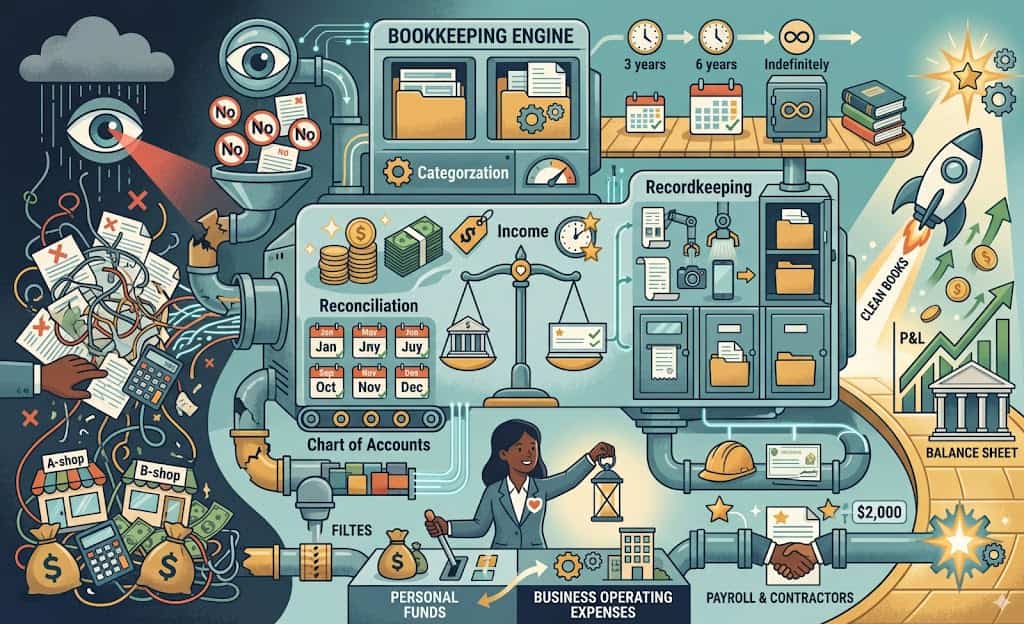
Bookkeeping is not just “tracking expenses.” In the U.S., bookkeeping is the foundation that proves your income, supports your deductions, and keeps your tax return consistent with what the IRS expects.
In 2026, the IRS is relying more on automated matching, digital records, and clean documentation. If your bookkeeping is messy (or nonexistent), you can end up overpaying taxes, missing deductions, triggering notices, or struggling during an audit.
Here is what you need to know to run U.S. bookkeeping the right way—simple, compliant, and built for growth.
- What “Bookkeeping” Means to the IRS (It’s Proof)
To the IRS, bookkeeping is how you record business transactions and keep the supporting documents that back up your tax return. Your records must be kept as long as needed to prove income or deductions, and your business transactions should be recorded from documents like sales records, receipts, and payroll records.
If your books can’t clearly explain your revenue and expenses, your tax return becomes harder to defend.
- Separate Books = Cleaner Taxes (Especially If You Have More Than One Business)
Many business owners mix money across accounts and businesses—until tax time gets painful.
The IRS guidance for starting a business emphasizes keeping a complete and separate set of books and records for each business, and having an accounting system that clearly shows income.
The rule of thumb is simple:
One business = one set of books (and ideally, separate bank/credit accounts).
- The Core Bookkeeping System (What “Good Books” Include)
A strong bookkeeping system usually includes these basics:
- Chart of accounts (income, expenses, assets, liabilities)
- Categorizing every transaction (not just “bank balance = profit”)
- Reconciling bank + credit cards every month (so numbers match reality)
- Attaching receipts and invoices (so deductions are supportable)
- Tracking payroll and employment taxes (if you have employees)
- Tracking contractor payments (for potential 1099 filing)
- Separating sales tax collected (varies by state, but should not be treated as income)
This is how you create books that are “audit-ready” instead of “tax-season panic.”
[Image suggestion: A clean bookkeeping dashboard showing monthly reconciliation + P&L summary]
- Cash vs. Accrual: The Accounting Method Behind Your Books
In the U.S., bookkeeping isn’t only “what you spent.” It also depends on your accounting method—because that affects when income and expenses are counted.
The IRS explains it like this:
- Cash method: report income when you receive it; deduct expenses when you pay them.
- Accrual method: report income when you earn it; deduct expenses when you incur them.
And once you set your accounting method, you generally need IRS approval to change it.
- Receipts and Recordkeeping: How Long Should You Keep Documents?
This is one of the most important parts of bookkeeping—and one of the most ignored.
The IRS states you must keep records as long as needed to prove your income or deductions.
Common IRS timeframes include:
- 3 years in many standard cases (general limitation period)
- 6 years if you underreport income by more than 25%
- Indefinitely if you don’t file a return or file a fraudulent return
- Employment tax records: at least 4 years after the tax is due or paid (whichever is later)
- Contractor Payments + 1099s: Bookkeeping Protects You Here
If you pay independent contractors, bookkeeping must track vendor totals and collect W-9s early—because you may need to file Form 1099-NEC.
The IRS says you generally must report payments as nonemployee compensation when you pay $600 or more for services during the year—but notes the threshold becomes $2,000 for payments made after December 31, 2025 (and adjusts for inflation thereafter).
That means in 2026, your vendor tracking matters even more—not only for compliance, but to avoid last-minute chaos in January.
- Monthly Close: The “Professional” Habit That Saves Taxes and Stress
The businesses that grow smoothly aren’t necessarily the ones that earn the most—they’re the ones that close their books monthly.
A strong monthly close includes:
- Reconcile accounts
- Review a Profit & Loss (P&L)
- Review a Balance Sheet
- Confirm owner draws/distributions are recorded correctly
- Flag weird transactions early (instead of finding them 10 months later)
This is how you stop guessing and start managing.
Why Accounting Heart Makes Bookkeeping Simple (and Tax-Ready)
Many people think bookkeeping is “extra.” In reality, bookkeeping is how you avoid tax surprises and build a real business.
At Accounting Heart Business Solution (Accoheart), we help clients:
- Set up clean books that clearly show income (IRS-friendly structure)
- Choose and maintain a consistent accounting method (cash vs accrual)
- Build a documentation system aligned with IRS recordkeeping expectations
- Track contractor payments for 1099 readiness
- Close books monthly so tax filing is fast, accurate, and low-stress
Your business deserves books you can trust.
👉 [Contact Accounting Heart today] for bookkeeping that keeps you compliant—and helps you grow confidently.